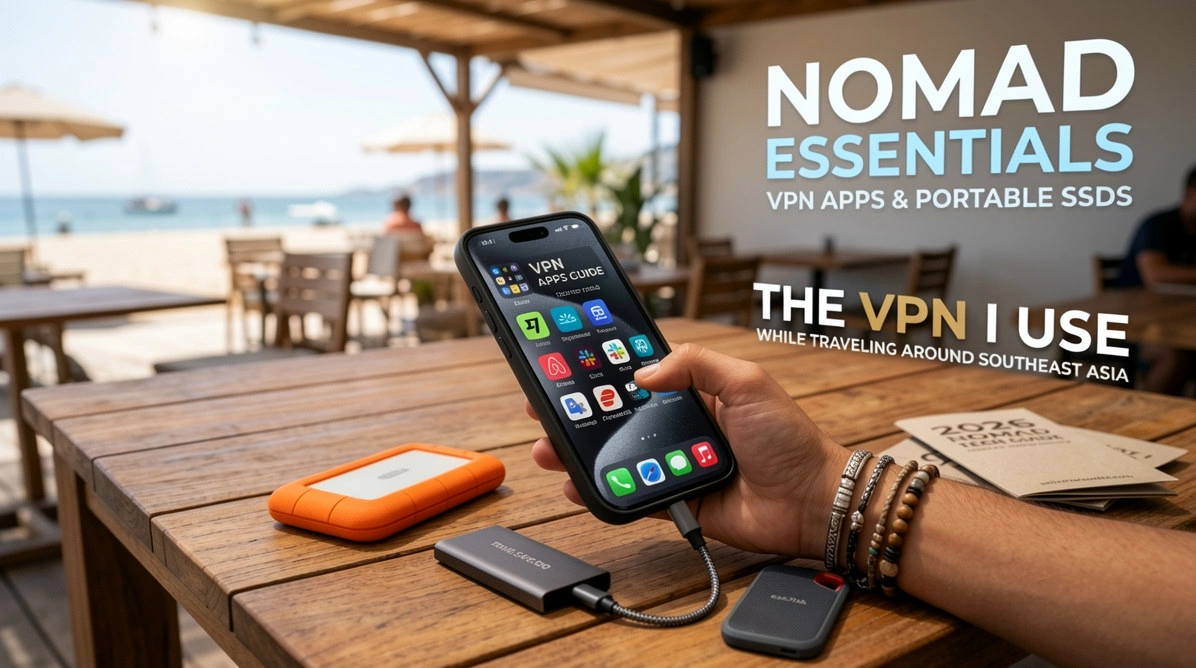
Traveling across Southeast Asia sounds like nonstop cafés, beaches, and cheap flights—but the part nobody talks about is how often your internet gets unpredictable.
Some Wi-Fi networks block tools you rely on. Some hotels throttle bandwidth. Some public networks are just… not worth trusting.
That’s why a VPN isn’t optional in my setup—it’s part of the baseline infrastructure for remote work.
Here’s the VPN setup I actually use while moving between Singapore, Thailand, Vietnam, Malaysia, and Indonesia, plus how I decide what to turn on and when.
Why a VPN matters more in Southeast Asia than you think
In this region, VPNs are not just about “privacy” in the abstract. They solve very practical problems:
- Accessing work tools on restricted or unstable networks
- Preventing data leaks on public Wi-Fi (airports, cafés, coworking spaces)
- Avoiding weird throttling on video calls
- Keeping logins stable when switching countries frequently
- Accessing services that behave differently by region
My core VPN stack (what I actually use)
I don’t rely on just one VPN. I rotate between two main ones depending on speed vs stability.
1. NordVPN — my “default work VPN”
This is the one I keep on most of the time.
Why it works well in Southeast Asia:
- Very stable across multiple countries
- Consistently strong speeds for Zoom/Google Meet
- Large server network (easy to switch when one IP gets blocked)
- Reliable for accessing work dashboards and cloud tools
2. ExpressVPN — my “backup when networks get weird”
This one is less about features and more about reliability in difficult networks.
I switch to it when:
- Hotel Wi-Fi refuses to connect properly with other VPNs
- I’m stuck on airport networks with heavy restrictions
- I need a clean connection for urgent client calls
- Other VPNs start randomly dropping packets
3. Surfshark — my “multi-device + budget layer”
This is the VPN I recommend if you’re:
- Running multiple devices (laptop + phone + tablet)
- Sharing access with a partner or team
- Trying to keep monthly costs low
How I actually use VPNs day-to-day
Most people overcomplicate VPN usage. My setup is intentionally simple:
Morning setup (work mode)
- Connect to Singapore or nearby SEA server
- Open Slack, Notion, Google Workspace
- Run calls through VPN if hotel Wi-Fi is unstable
Midday café work
- Switch server closer to current location if speed drops
- Turn off VPN only if I need maximum upload speed for large files
Evening browsing
- Often keep VPN on for general safety
- Switch to streaming-optimized servers if needed
The biggest mistake digital nomads make with VPNs
People usually pick a VPN based on:
- ads
- influencer recommendations
- “fastest” claims
consistency across bad Wi-Fi, not peak speed on perfect Wi-Fi
A VPN that is “fast sometimes” is worse than one that is “stable always.”
Quick comparison (real-world use)
- NordVPN → best all-around workhorse
- ExpressVPN → best “nothing is working, fix it now” option
- Surfshark → best value + multi-device setup
Final thought (practical, not theoretical)
In Southeast Asia, your VPN isn’t about hiding—it’s about stabilizing your work environment across unstable networks.
Once you stop thinking of it as a privacy tool and start treating it like a “connection layer,” everything becomes simpler.