
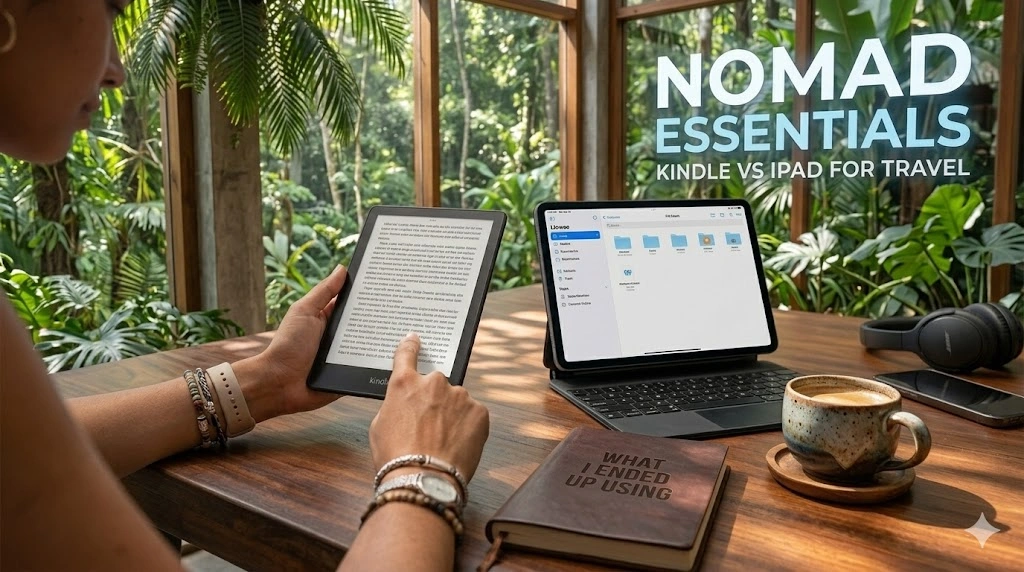
When you travel full-time as a digital nomad, your devices stop being “nice-to-have” and become part of your survival system. You quickly realize that every extra gram in your bag, every hour of battery life, and every distraction on your screen actually affects how you work and live on the road.
I used both a Kindle and an iPad while traveling across different countries, switching between them depending on my workload and lifestyle at the time. Over time, I didn’t just compare specs—I learned how each device actually fits into real travel life.
The Core Difference: They Don’t Compete
A lot of people compare Kindle and iPad as if they are direct competitors, but in real travel use, they solve completely different problems.
- Kindle = focused reading and mental downtime
- iPad = productivity, work, and multi-purpose travel tool
Kindle on the Road: Simple, Light, and Focused
The Kindle became my “slow travel companion” when I wanted to disconnect from work.
What I liked most
The biggest advantage is focus. There are no notifications, no apps pulling your attention, and no temptation to switch tasks. It’s just you and the book.
Other advantages:
- Extremely light and easy to carry
- Battery lasts for weeks
- Very comfortable reading even in sunlight
- Feels close to reading a physical book
What I didn’t like
The limitation is obvious—it only does one thing. If you want to take notes, manage work, or plan travel, it’s not enough.
iPad on the Road: The Real Work Machine
The iPad became my main device when I needed to actually get work done while traveling.
It fits naturally into a remote work travel setup, especially when combined with productivity tools and apps (I break down my setup here):
What I liked most
The iPad is flexible. It’s not just for entertainment—it can handle writing, planning, emails, and light creative work.
In cafés, coworking spaces, or even airport lounges, it became my daily tool.
Key advantages:
- Works for writing, planning, and communication
- Great for travel logistics and organizing work
- Can replace a laptop for light tasks
- Strong ecosystem of productivity apps
What I didn’t like
But it comes with trade-offs:
- Battery drains faster than Kindle
- More distractions (apps, notifications, YouTube, etc.)
- Heavier and less “invisible” in your bag
- Reading feels good, but not as relaxing as Kindle
Real Travel Scenarios: What I Actually Used
This is where the difference became obvious in real life.
✈️ Flights and long transit
iPad wins easily. Offline videos, work, and multitasking make it more useful.
☕ Cafés and coworking spaces
iPad again. It becomes a lightweight work station.
🏝️ Slow travel days (beach, nature, downtime)
Kindle wins. No distractions, just reading and rest.
🧳 Minimal packing or short trips
Kindle is better because it takes almost no space or mental load.
My Final Decision as a Digital Nomad
After switching between both devices for a long time, I realized something simple:
I don’t need both for everything—but I do prefer both for different parts of travel life.
If I had to choose only one device today:
👉 I would choose the iPad.
Not because it is better at reading, but because it covers more of my actual work needs on the road.
However, the Kindle still has a unique role—it’s the only device that truly helps me disconnect without distraction.
When You Should Choose Kindle
Choose Kindle if:
- You mainly read books while traveling
- You want zero distractions
- You prefer ultra-light packing
- You travel slowly and prioritize downtime
When You Should Choose iPad
Choose iPad if:
- You work remotely while traveling
- You need one device for multiple tasks
- You manage writing, planning, or content creation
- You want a laptop alternative for light work
Final Thoughts
The Kindle vs iPad debate isn’t really about which device is better.
It’s about how you travel.
If your travel style is about slowing down and reading more, Kindle is unbeatable. If your travel style is about working, creating, and staying productive anywhere, iPad becomes essential.
For me, the iPad ended up being the more practical long-term choice—but the Kindle is still the best device for escaping noise and staying focused on one thing at a time.