
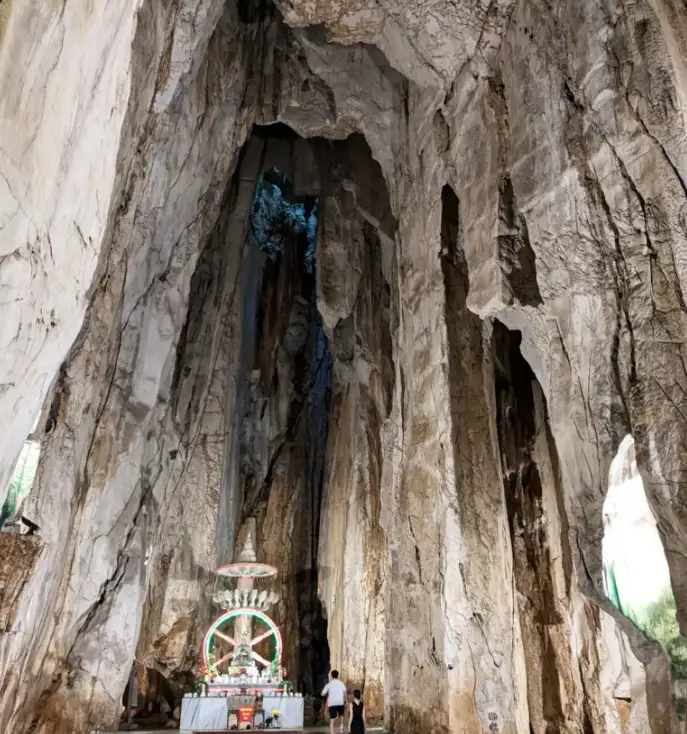
I showed up at Marble Mountains on a Saturday at 10 AM once. Bad call. Tour buses had already parked, the stone steps were warm under my sandals, and every cave entrance had a line of people holding phones up to the dark. The second visit I copied what locals do: arrive near opening, start on Thuy Son (the main mountain), and treat the place like a morning workout with temples attached. That version felt completely different — quieter stairs, actual breeze in Huyen Khong Cave, and enough space to stand still and look up without someone’s elbow in my ribs.
What Are the Marble Mountains & Why Visit
The Marble Mountains (Ngu Hanh Son) are five limestone and marble outcrops between Da Nang and the beach strip toward Hoi An. For centuries they were carved for stone; today they are a cluster of caves, Buddhist shrines, and short summit views over rice fields and the coast. You do not need a geology lecture to enjoy them — you need legs, water, and tolerance for stairs.
People come for three things: caves that open to the sky, small pagodas tucked into rock, and the odd satisfaction of climbing something in a city that is otherwise flat along the sea. It is not a wilderness park. It is a managed site with ticket gates, vendors, and marble workshops at the foot. That honesty helps set expectations.
Is Marble Mountains Worth Visiting? (What to Expect)
Yes, once — especially if you like light-and-shadow places or you want one structured “sight” day without driving to Ba Na. It is not an all-day epic unless you make it one by shopping and eating slowly at the base.
Expect:
- Heat and humidity on exposed steps from late morning onward
- Short climbs between cave levels, not alpine hiking
- Incense smoke in active shrines — bring tissues if smoke bothers you
- Tour groups from mid-morning; they cluster at Huyen Khong and the elevator
Difficulty Level: Is It Hard to Climb?
Moderate for average fitness, not technical. The famous stairs are steep and uneven, but handrails exist on many sections. I am not a hiker; I managed in trainers with decent grip. Flip-flops are a hard no — polished stone plus humidity equals slides.
Elevator option: A lift takes you partway up Thuy Son for a separate fee. I used it once when recovering from a cold; walking took maybe fifteen extra minutes but felt more satisfying.
Kids and knees: School-age kids can do it with breaks. Bad knees? Take the elevator, limit to one mountain, skip the tightest cave passages.
Altitude: You are not high enough for altitude issues. The challenge is heat and steps, not thin air.
Best Time to Visit & How Long to Stay
Best time: Gates open early — aim for 7–8 AM if you can. Light in Huyen Khong Cave is softer, and the air still carries last night’s cool. After 10 AM, groups multiply. Late afternoon can work in cooler months but shadows move fast inside caves.
How long: Two to three hours covers Thuy Son’s main caves and one viewpoint. Add thirty minutes if you wander marble shops or drink coconut water at the bottom watching artisans grind stone.
Season note: Rain makes steps slick. If it poured overnight, wear shoes with real tread and skip rushing.
Top Caves You Should Not Miss
Huyen Khong Cave is the headline — a tall chamber with a natural hole in the roof where light pours down onto altars. Go when you can see the beam, not when the chamber is packed. Voices echo; whisper if you are taking it seriously as a shrine.
Am Phu Cave (“Hell Cave”) is darker, narrower, and more theatrical — statues and scenes about the afterlife. Some travelers love it; others find it kitschy. I thought it was worth twenty minutes if you are already on the mountain, but skip if claustrophobia is real.
Tang Chon Cave and smaller openings on Thuy Son reward a slow walk — less crowd, more tree roots over stone. I liked the smaller gaps because they smelled like wet rock and incense instead of sunscreen.
Bring a small torch only if you want; paths are lit enough for normal walking.
Temples, Pagodas & Viewpoints
Pagodas here are working places, not museum sets. Cover shoulders, lower voice near altars, and do not pose on prayer mats. The Linh Ung Pagoda on Thuy Son gives you the classic “temple between rock and sky” photos.
Viewpoints toward the east show Da Nang’s coastline on clear days — haze hides it sometimes, so do not blame your camera if the city looks like a watercolor wash. Sunset from the mountains is possible but logistically awkward; most people visit mornings.
Tickets, Opening Hours & What to Bring
Ticket prices change; check at the gate the day before. There is a base entrance plus optional elevator fee. Cash is useful; cards increasingly work but do not rely on them at small counters.
Bring:
- 1–1.5 liters of water per person in hot months
- Non-slip shoes
- Thin scarf or shirt for temple modesty
- Small bills for toilet tips and coconut stalls
Opening hours are typically morning to late afternoon; confirm locally because holiday hours shift.
Suggested Route + Local Tips (Avoid Mistakes)
Route I repeat:
- Enter early, head straight to Thuy Son elevator or main stair path
- Huyen Khong Cave first while light is good
- Loop pagodas and a viewpoint before heat peaks
- Optional Am Phu if lines are short
- Exit to marble street for a cold drink — watch artisans, buy small souvenirs only if you will carry them
Mistakes I watched others make:
- Arriving at noon with no water
- Wearing slide sandals on wet steps
- Trying to “do all five mountains” in one go — you will burn out; one main mountain is enough
- Chasing every shop demo — the stone carving is interesting for ten minutes, not two hours
Marble Mountains rewarded me when I treated them like a morning ritual, not a trophy photo stop. Show up early, climb once, breathe in the cave cool, and leave before the buses turn the stairs into a queue.