I tried to "complete" Chiang Mai's Old City in one aggressive day — six temples, three coffee shops, a cooking demo I didn't care about, and a moat lap at noon when the sun felt personal. By 2 PM I was irritable, dehydrated, and taking photos out of obligation. The second attempt had no checklist: start at Tha Phae Gate, walk until something interesting appeared, stop when hungry. Same square kilometer, completely different city. The Old City is where Chiang Mai stops feeling like a nomad hub and starts feeling like a place people have lived for centuries — but only if you walk it at human speed.
Old City Overview
The historic core is a roughly square district surrounded by a moat and remnant walls, with gates at the cardinal points. Tha Phae Gate (east) is the most familiar entry for visitors; Chang Phueak (north), Suan Dok (west), and Chiang Mai Gate (south) anchor other loops. Inside, temples, guesthouses, woodcarving shops, and quiet sois interleave with tuk-tuk traffic and scooter flow.
This is not a museum diorama. People live here, monks commute, schools let out, markets set up on irregular schedules. The slow-travel goal is not to see every wat on a map — it is to pick a direction, accept detours, and repeat the walk on day three when you already know where the shade sits at 10 AM.
The full moat circumference is about 6 km. You do not need to walk all of it in one go. My favorite days cover one quadrant slowly, then return the next morning for another.
Morning: Tha Phae Gate to Wat Chedi Luang
Start near Tha Phae Gate when light is still gentle — ideally before 8:30 AM. Grab khao soi from a cart; don't overthink which one if a line of locals has already formed. The busy carts are busy for a reason.
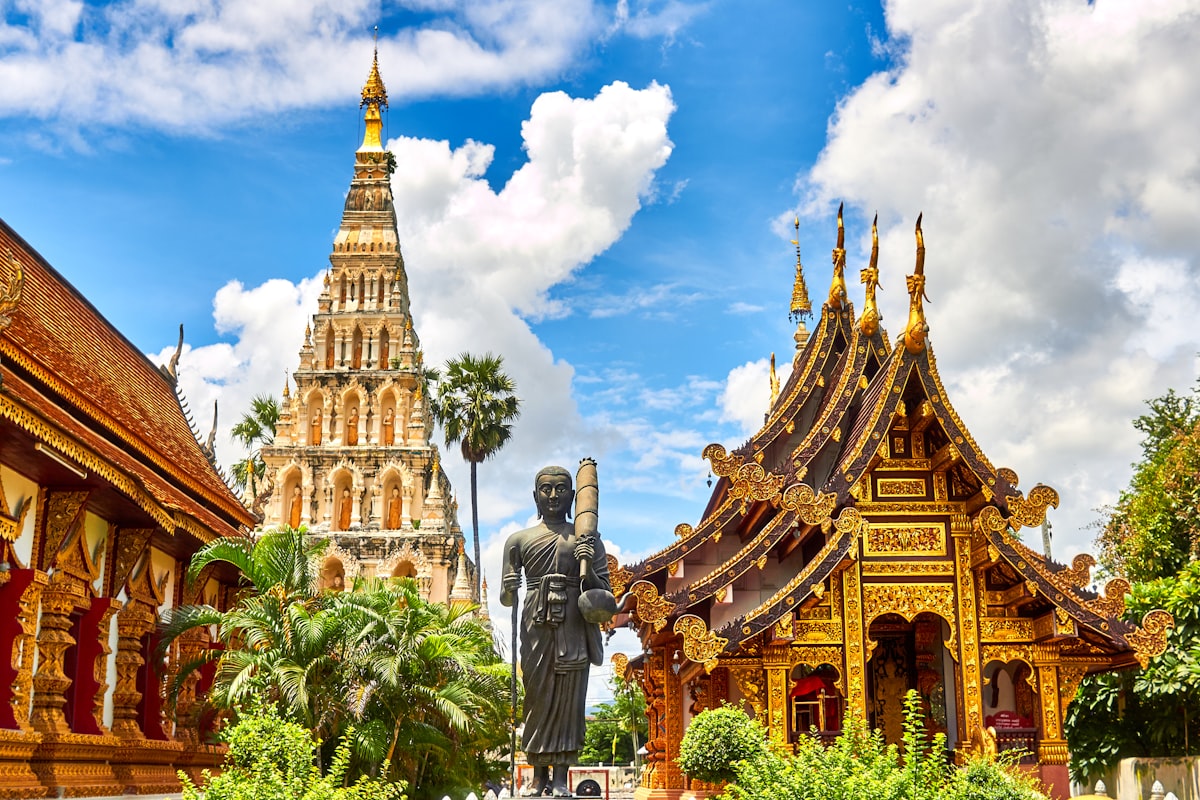
Walk west toward Wat Chedi Luang on Prapokkloa Road. This temple deserves unhurried time: the ruined chedi has a weight newer reconstructions don't carry. Sit in the shade. Watch how locals move through the space — merit offerings, brief prayers, monks on errands. I spend 30–45 minutes here on a first visit, less on returns when the chedi becomes a familiar landmark.
Dress code applies at active temples: shoulders and knees covered, shoes off in worship halls, quiet voice. Entry fees vary by temple; keep small bills.
If you want a mountain-temple contrast later in the week, save Doi Suthep for a separate early morning — the Old City is for flat, repeatable walks.
Midday: Moat Walk and Side Streets
Follow the moat counter-clockwise from the east gate if you want my default loop. The east and north sides are often quieter before lunch heat peaks. When the sun pushes back, duck into sois — woodcarving shops, silent courtyards, cats asleep on spirit houses, a tailor shop that hasn't updated its sign since 1998.
Midday is not the time for heroic walking. This is when I choose one indoor stop: a tea house, a temple hall with fans, or a long lunch. Trying to march the full moat at noon turns Chiang Mai into a endurance test — the city wins that fight.
Grab and songthaews are legitimate slow-travel tools. There is no prize for suffering through heat stroke cosplay.
Afternoon: Wat Phra Singh and Slow Tea
Wat Phra Singh is busiest around noon when tour groups overlap. Hit it earlier on a return day, or arrive after 3 PM when courtyards open up again. The viharn and surrounding halls reward slow circling, not a five-minute photo raid.
End the formal temple portion at a tea house on Ratchadamnoen — not the loudest one, the one where people are reading or talking quietly. Order something cold. Reset your feet.
Evening and Market Options
Sunday Walking Street (Ratchadamnoen and branching sois) is famous for a reason — handmade crafts, street food, and slow-moving crowds. If you want that energy, plan the walk to finish into Sunday evening. For quieter market browsing, Tuesday through Thursday evenings on overlapping streets often mean fewer stalls but more room to breathe and actually taste food instead of queueing.
The dedicated Sunday Walking Street guide covers food pacing if you turn the walk into a market night — small portions, short walks between bites.
Food Stops Worth Building In
- Khao soi near Tha Phae for breakfast
- Mango sticky rice from a cart when in season
- Roti from a evening cart you walk past twice — that's your cart
- Northern Thai sausage at markets if you're curious and not already full
Practical Tips
- Water: buy cold bottles before long moat segments; refill when you see 7-Eleven
- Sun: hat, sunscreen, light long sleeves beat bare-shoulder temple rejection later
- Shoes: easy slip-on for temple shoe removal rhythm
- Maps: offline map helps in sois; don't over-pin — wandering is the point
- Scooters: park legally; walking is often faster inside the moat at peak hours
Who This Walk Suits
Great for first-time visitors who want culture without a tour bus, repeat visitors who missed the quiet sois, and remote workers on a weekday off who need a laptop-free day. Less ideal if you cannot walk 90 minutes total even at slow pace — in that case, songthaew between gates and walk one soi deeply.
Families work well here early; midday heat and scooter traffic need more caution with kids.
Sample Slow Day Timeline
- 7:30 AM — Khao soi near Tha Phae
- 8:00–9:30 AM — Wat Chedi Luang and nearby sois
- 9:30–11:00 AM — Moat segment + shade breaks
- 11:30 AM–1:30 PM — Lunch and indoor rest
- 3:00–4:30 PM — Wat Phra Singh + tea
- Evening — Optional market if energy remains